RepairDesk alternatives — an honest look at your options
If you're searching "RepairDesk alternative", something's prompted it. Maybe the bill went up when you opened a second site. Maybe you're paying for a POS module you never open. Maybe you're not a phone shop and you've slowly realised the software thinks you are.
Let's be fair to it first, then go through the options honestly.
What RepairDesk actually costs, and where it bites
RepairDesk publishes $99/month per store, dropping to about $79 if you pay annually.
The important word there is per store, not per user. That's genuinely better than the tiered-user model you'll find elsewhere — hiring your third technician doesn't move your bill. What moves your bill is opening a second shop, at which point it doubles. If you're a single busy location, RepairDesk's entry price is actually lower than RepairShopr's comparable tier.
Two things to read carefully before you commit to the annual rate. Payment is upfront, and their published terms say there are no refunds for downgrades. That's not unusual, but it does mean the annual discount is a real commitment: if you shrink, restructure or change your mind in month three, that money is spent.
And one thing worth knowing well in advance: RepairDesk removes your data after you cancel. Whatever you decide, export everything before you end the plan, not after.
Being fair: what RepairDesk does well
Before you look elsewhere, be clear about what you'd be giving up. Switching has real costs — time to migrate, time to relearn, and features you'll miss.
- It's been around long enough that most rough edges are known quantities
- The POS module is genuinely useful if you sell parts or accessories over the counter
- The phone repair workflow — IMEI lookup, pre-built repair types — is built specifically for phone shops
We should also correct something we'd previously heard repeated about their support. The public record doesn't support it: RepairDesk sits around 4.7 on Capterra across a couple of hundred reviews and higher again on Trustpilot, and responsive support comes up as a positive theme. If you're leaving, it shouldn't be over that.
If your shop is primarily walk-in phone repair with a counter and a till, RepairDesk was designed for you. The alternatives below won't have as deep a phone-specific feature set.
If you're a more general repair shop — electronics, consoles, appliances, computers, bicycles, anything that isn't specifically phones — RepairDesk was designed for someone else. You're using a phone-shop tool for a different kind of business, and paying for the parts of it you don't use.
The real alternatives
RepairShopr
The other well-known name. Longer in the tooth, broader feature set. Published plans run $69.99/month (Starter, one user) to $139.99 (Repair Shop) and $149.99 (Big Chain), around 15% off annually.
The structure is the opposite of RepairDesk's: tiers defined by locations and an included user allowance. So a second location is cheaper to add than it is on RepairDesk, but growing your team can push you up a tier. Which of the two is cheaper depends entirely on your shape — model it against your own headcount and site count rather than comparing headline prices.
Hubtiger
Comes up most often in bicycle and motorcycle repair, and also serves jewellery and watch shops. Worth a look if you're in one of those niches. Less proven for electronics.
Spreadsheets and WhatsApp
This sounds like a step backwards, but plenty of small shops run efficiently on a Google Sheet for jobs, a shared WhatsApp number for customers, and a basic invoice tool.
If you're solo and doing fewer than ten jobs a week, "better software" probably isn't your problem — complexity is. Spreadsheets don't charge per store either.
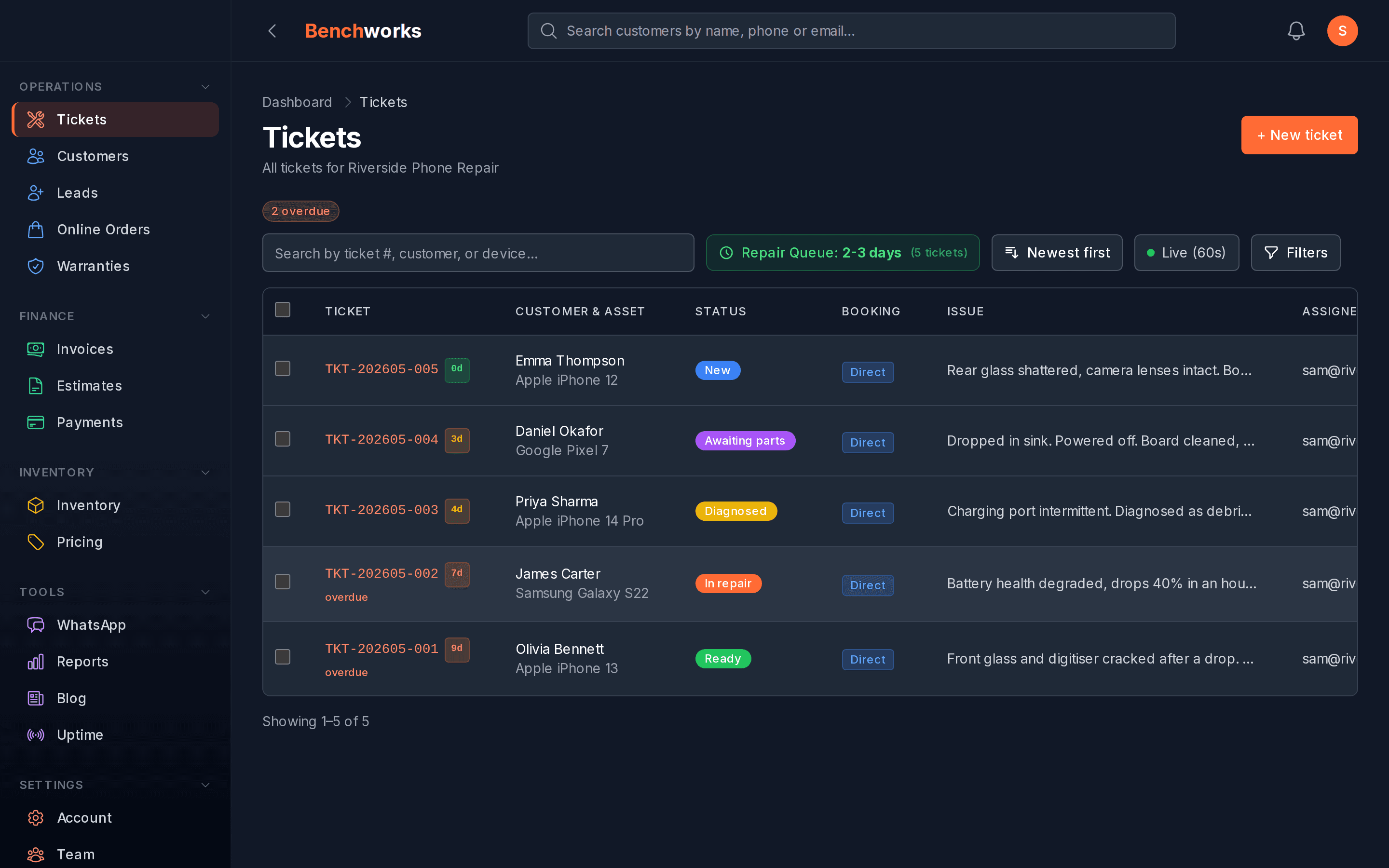
Benchworks
We built Benchworks because we had the same frustrations you're probably feeling.
The honest version: we're newer, so you're not getting ten years of bug fixes or a full POS. What you do get is $59 a month flat — one shop, unlimited technicians, and the first 100 shops locked in at $29 for life. No per-store multiplier, no annual lock-in, and no markup on your messaging because you connect your own WhatsApp Business Account and Meta bills you directly.
Your data comes out in one file from your settings — every table as CSV and JSON — any time, no ticket, no fee. And cancellation is one click, after which your account stays readable and exportable for 90 days rather than disappearing.
Benchworks is built for drop-off repair shops across verticals, not specifically for phone shops with a till. If you run a counter-sale-heavy phone shop, we'd rather tell you that now than have you sign up and be disappointed.
See the pricing — there's one number and no tiers to decode.
What to check before you commit to anything
1. How do I get my data out? Every shop has years of customer records, ticket history and invoices. Before you move, run an export from your current platform and make sure you can actually read it, not just download it. RepairDesk's exports come module by module and some arrive as Excel files by email. Make sure your new platform has a clear export path too — you don't want this problem again in three years. Our migration guides cover the actual steps for the common systems, and there's a fuller guide to getting your data out here.
2. What happens to my WhatsApp number? If you've been running a WhatsApp Business number through your current software, find out what happens to it when you leave — in some setups the number is tied to the provider's account rather than yours. Worth knowing that Meta now supports running the same number on the Cloud API and the WhatsApp Business app together, so you're not forced to give up the app your front desk uses.
3. What does the contract actually say? Month-to-month or annual? Is payment upfront? What's the cancellation process, and does the data survive it? These things are in the terms for a reason. Read them before you sign, not after you want to leave.
4. Can I trial it with my own data? Demo environments with dummy data always look slick. Ask whether you can import a small CSV of your real customers and run a job end to end. The gap between "demo" and "this is my actual shop" is where the problems live.
The honest answer
The best repair shop software is the one your team will use without you having to push them. Usually that means: not too complicated, not too slow, and not so expensive that you resent opening it.
RepairDesk is a good tool that fits a specific shape of shop. If you're that shape, stay. If you're not — or if a second location just doubled your bill — it's worth looking.
If you want to try Benchworks without committing, sign up: no card, no lock-in, first three months free, and your data is exportable from day one.
If it's not the right fit, we'd rather you find that out during the free months than after you've already cancelled something else.